
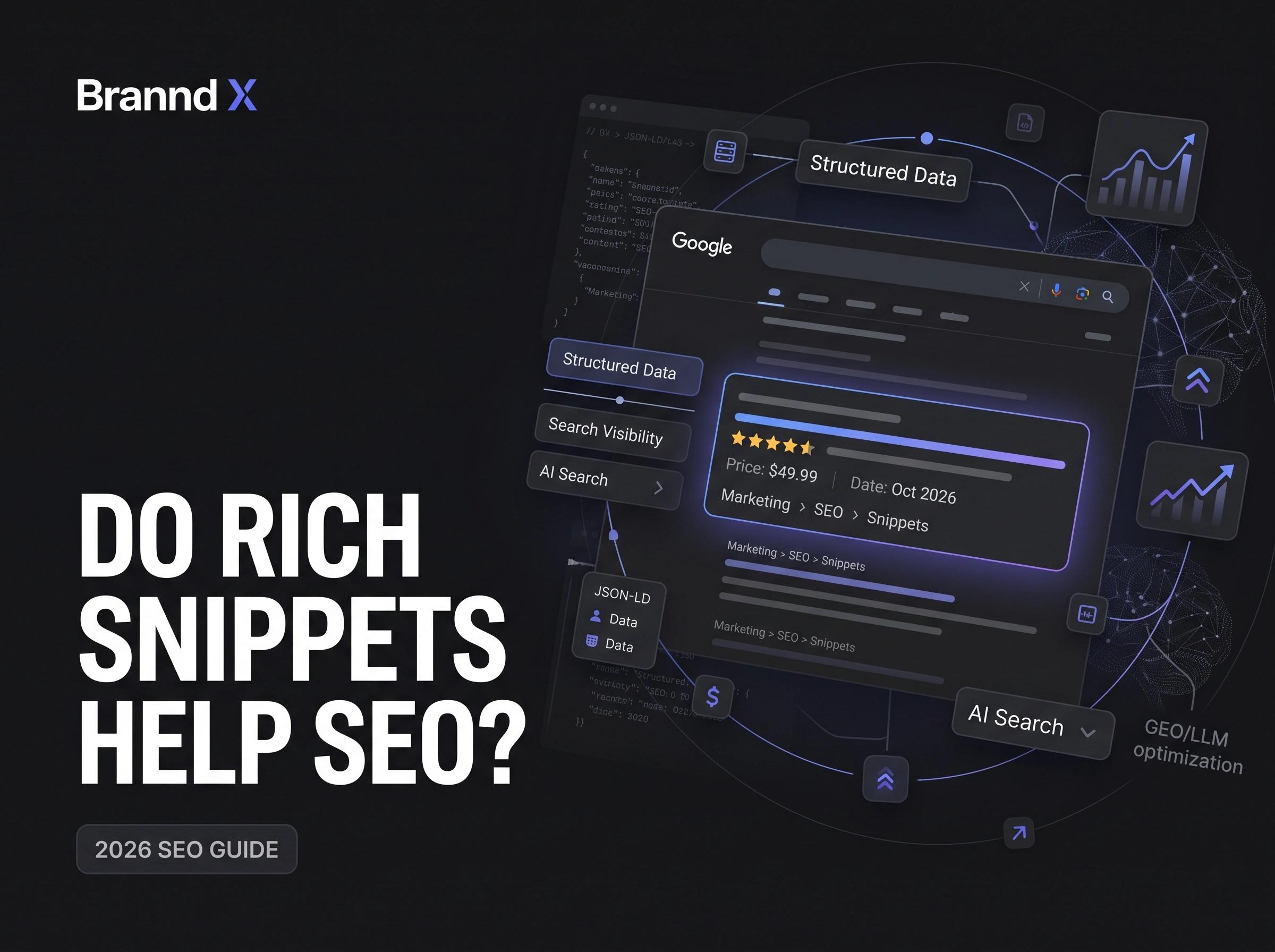
Yes, rich snippets help SEO but not as a ranking factor. They boost click-through rate and SERP visibility, and structured data more broadly helps search engines and AI systems understand your content. However, 2026 has been the most disruptive year for rich snippets in nearly a decade: Google retired FAQ rich results in May and removed seven more schema types in June. If you're still optimizing for 2024-style rich snippets, this guide explains exactly what changed and what to do instead.
A quick terminology note: Google generally refers to these enhanced search appearances as "rich results" in its own documentation. "Rich snippets" is a widely used SEO industry term for the same features this guide uses both interchangeably, matching how most people actually search for this topic.
What Are Rich Snippets?
Rich snippets are enhanced search listings that display extra information pulled from structured data (schema markup) on your page star ratings, prices, cooking times, event dates, or breadcrumbs instead of a plain title and description.
They are generated using Schema.org vocabulary, most commonly written in JSON-LD format, embedded in your page's code. Google reads this markup, understands your content more precisely, and if your page qualifies displays extra visual elements in the search results.
Do Rich Snippets Directly Affect Google Rankings?
No. Google has repeatedly and explicitly confirmed that structured data is not a ranking factor. Adding schema markup does not move you up the results page on its own.
What it does is make you eligible for enhanced visual treatment in the SERP and that visual treatment influences how often people click on you, which is where the real SEO value comes from.
This has not changed in 2026. What has changed is which rich results even exist anymore, and how structured data is used outside of traditional search.
The 2026 Rich Snippets Timeline: Every Major Google Update So Far
This is the section most SEO blogs are missing, and it's the reason older "do rich snippets help SEO" articles are now outdated.
| Date (2026) | Update | Impact |
|---|---|---|
| March 2026 | Core update reduced rich result display for schema types placed on pages where the markup wasn't the primary content (FAQ, Review, HowTo abuse cases) | Sites using FAQ/Review schema decoratively lost rich result eligibility |
| May 7, 2026 | Google officially retired FAQ rich results from search — the visual expandable Q&A snippet is gone after nearly nine years | FAQ schema no longer produces a visible rich result; FAQ data is removed from Search Console (June) and the API (August) |
| June 3, 2026 | Google launched new AI performance reports in Search Console, showing impressions inside AI Overviews, AI Mode, and generative Discover | SEOs can now measure AI-surface visibility directly, separate from traditional organic clicks |
| June 12, 2026 | Seven more schema types retired: Book Actions, Course Info, Claim Review, Estimated Salary, Learning Video, Special Announcement, Vehicle Listing | Simplification effort confirmed by Google's Search team; sites using these types quietly lost rich result eligibility |
| Ongoing (2026) | "Preferred Sources" controls expanded into AI Overviews | Publishers gained more say in which sources feed Google's AI-generated answers |
What this means practically: if your current content strategy leans on FAQ schema for rich snippet real estate, that specific benefit no longer exists in the SERP. Keep FAQ content for user clarity but stop expecting it to produce an expandable rich result or treat it as a special AI-citation signal.
How Rich Snippets Help SEO (Indirect Benefits)
Even with 2026's changes, structured data still delivers real, measurable value in three areas:
1. Higher Click-Through Rate
Google's own published case studies show meaningful CTR gains from rich results: Rotten Tomatoes recorded a 25% CTR lift, and Nestlé reported an 82% CTR increase after implementing structured data on relevant pages. These are Google-verified examples, not third-party estimates.
2. SERP Real Estate (Reduced, Not Eliminated)
Rich results still take up more visual space than a plain blue link but with FAQ snippets gone, this benefit is now concentrated in Review, Product, Recipe, Event, and HowTo types rather than spread across the board.
3. Clearer Attribution and Entity Understanding
Author and Organization information can help Google better understand who created the content and which organization is associated with it. This supports clearer attribution and entity understanding, but structured data itself is not a direct E-E-A-T ranking factor. Google's own Article documentation does recommend including author information, particularly for YMYL (Your Money or Your Life) content like health, finance, and legal pages.
Rich Snippets vs. Featured Snippets vs. Schema Markup
These three terms get confused constantly, so here's the distinction in one place:
- Schema markup — the code you add to your page (the input)
- Rich snippets — the enhanced visual result Google may display because of that code (the output)
- Featured snippets — a separate "position zero" answer box pulled from your page's content, not from schema markup
You can have all three, none, or any combination they don't depend on each other.
Rich Snippets, AI Overviews & AI Mode: What Changed in 2026
This is the part of the SEO conversation that changed the most this year, and where most competing content on this topic falls short.
Google's official position remains conservative here: structured data helps Google understand your content more accurately, and for AI features specifically, Google says your markup should match your visible content it does not confirm schema as a special AI ranking or citation signal. Some SEO practitioners interpret this comprehension benefit as an indirect "trust signal" for AI systems, but that framing is an industry interpretation, not an official Google claim, so treat it as a plausible mechanism rather than a confirmed one.
A few third-party data points worth knowing (observational research, not Google-confirmed figures):
- A Proton Effect analysis citing Ahrefs data reported that only around 38% of pages cited in Google AI Overviews (February 2026 sample) also ranked in the traditional top 10 down from roughly 76% in mid-2025. If accurate, this suggests traditional ranking position and AI citation are becoming more separate games, though this is a third-party study, not a Google-published figure.
- Google's own official May 2026 guidance on optimizing for AI features is more cautious than most SEO commentary: don't rewrite content specifically for AI, don't "chunk" content artificially, and don't over-invest in structured data expecting it to become a special AI signal. Structure your data because it's accurate not because you're chasing an AI-specific hack.
- JSON-LD is Google's explicitly recommended format for structured data, and is generally easier for automated systems to parse cleanly since it lives in a separate script block rather than being woven through your HTML like Microdata or RDFa. That said, Google still supports all three formats "JSON-LD only" is a best-practice recommendation, not a hard technical requirement.
GEO & AEO: Optimizing Rich Snippets for ChatGPT, Perplexity, and AI Search
Generative Engine Optimization (GEO) is the practice of structuring content so AI systems ChatGPT, Perplexity, Gemini, Copilot, and Google's own AI Overviews cite you inside their generated answers. Answer Engine Optimization (AEO) is a subset of GEO focused specifically on answer-style surfaces like featured snippets and AI Overviews.
The critical mindset shift: GEO targets citation frequency, not ranking position. These are third-party industry findings, not Google-published data, and should be treated as directional rather than definitive but multiple independent studies point the same way:
- Erlin.ai's 2026 GEO trends report cites data suggesting fewer than 10% of sources cited by ChatGPT, Gemini, and Copilot rank in the Google top 10 for the same query, and that pages ranking #1 have roughly a 58% chance of AI Overview citation, dropping to around 14% by position 10 (attributed to a "Growth Memo, April 2026" analysis).
- GoGoChimp's GEO reference guide cites a Profound (2026) finding that roughly 80% of AI-cited pages use lists or structured elements, and a Muck Rack + Seer (2026) analysis suggesting third-party trust signals can substantially lift citation likelihood.
- ClickForest's GEO strategy guide, referencing a Princeton-affiliated GEO study (arXiv:2311.09735), notes that adding sourced statistics, direct quotes, and explicit citations each independently improved AI visibility by roughly 25-30% over baseline content in controlled testing, while keyword stuffing performed below baseline.
What these findings converge on, directionally:
- Structured, extractable content lists, tables, and clearly labeled sections
- Original statistics with a clear, named source rather than vague or unsourced claims
- Direct expert quotes and explicit citations
- Short paragraphs (2-3 sentences) that lead with the answer before adding context
- Freshness AI systems appear to favor recently updated content over static evergreen pages
- Fan-out query coverage when someone asks an AI a complex question, the system breaks it into smaller sub-queries and searches each separately; covering those sub-questions inside your article increases your chances of being pulled into more than one part of the answer
Caveat worth stating plainly: none of these percentages come from Google, OpenAI, or Anthropic directly they're third-party observational studies with varying methodologies and sample sizes. Use them as reasonable planning signals, not guarantees, and re-check them periodically since this research area is moving fast.
Schema markup can help Google understand page content and entities, but Google does not describe it as a special ranking or citation signal for AI features. Use structured data including FAQ, Organization, and LocalBusiness schema when it accurately represents the visible content on the page, not as an AI optimization tactic.
LLM & AI Optimization Checklist for This Content Type
- Lead every major section with a direct, one-sentence answer before elaborating
- Prefer JSON-LD for structured data; use Microdata or RDFa when appropriate and correctly implemented
- Keep FAQ-style content sections even without the visual rich result — FAQ rich results are no longer available in Google Search, but clear FAQ-style content can still make a page easier for users and automated systems to understand. Do not treat FAQ schema as a special AI-ranking or citation signal.
- Add accurate Author and Organization structured data to improve attribution and entity understanding
- Include original statistics or first-party data wherever possible
- Update the page regularly and show a visible "last updated" date
- Structure content in scannable lists and short paragraphs, not dense blocks
- Validate everything against the current supported schema list deprecated markup won't hurt rankings, but it clutters your code and triggers Search Console warnings
Types of Rich Snippets Still Active in 2026
| Snippet Type | Status | Best For |
|---|---|---|
| Product | Active | E-commerce pages |
| Review / Rating | Active (stricter eligibility post-March 2026) | Products, services, local businesses |
| Recipe | Active | Food and cooking content |
| Event | Active | Webinars, conferences, ticketed events |
| HowTo | Active (stricter eligibility) | Step-by-step tutorials |
| Breadcrumb | Active | Site navigation/structure |
| LocalBusiness | Active | Local SEO, "near me" queries |
| Job Posting | Active | Careers pages, job boards |
| Article | Active | News, blog content |
| FAQ | Retired (May 7, 2026) | No longer a visual rich result keep the schema for AI/entity purposes only |
| Book Actions, Course Info, Claim Review, Estimated Salary, Learning Video, Special Announcement, Vehicle Listing | Retired (June 12, 2026) | No longer supported in any form |
Rich Snippets by Industry
- Local SEO: LocalBusiness schema remains one of the strongest levers for "near me" queries and knowledge panel eligibility
- E-commerce: Product schema with pricing, availability, and reviews directly supports both classic rich results and AI shopping citations
- Recipes: Recipe schema (cook time, calories, ratings) remains one of the highest-CTR-impact snippet types
- Real Estate: Structured listing data helps AI systems surface property details accurately in local and comparative queries
- Legal & Medical: Author and Organization schema matter more here than any other industry due to YMYL trust requirements
- Travel & Hotels: Event and LocalBusiness schema combine well for destination and booking-related queries
- Software & Apps: Product/SoftwareApplication schema helps with comparison-style AI queries
- Job Postings: Still fully supported and high-value for career pages
How to Implement Rich Snippets — Step by Step
- Choose the correct schema type from Schema.org that matches your actual page content never mark up content that isn't genuinely present.
- Prefer JSON-LD Google recommends it as the easiest format to implement and maintain, since it lives in a separate script block rather than being woven through your HTML.
- Validate before publishing using Google's Rich Results Test and the Schema.org Validator.
- Monitor in Search Console check the Enhancements section for errors, and use the new AI performance reports to track AI Overview and AI Mode impressions separately from organic clicks.
- Audit quarterly Google's supported schema list changes more often than most SEO advice accounts for; deprecated markup should be cleaned up even though it won't directly hurt rankings.
Common Mistakes to Avoid in 2026
- Marking up hidden or absent content — results in loss of rich result eligibility, and in worse cases, manual action
- Using deprecated schema types (FAQ for visual results, Book Actions, Course Info, etc.) expecting a rich result that no longer exists
- Fake or inflated review data — a direct violation of Google's guidelines
- Treating schema as an "AI hack" — Google's own guidance says structured data is not a special AI ranking signal; it helps because it's accurate, not because it's clever
- Ignoring Core Web Vitals — Google's 2026 targets (LCP under 2.5s, INP under 200ms, CLS under 0.1) increasingly interact with how well AI systems and rich results perform on a page
Frequently Asked Questions
Do rich snippets guarantee higher rankings?
No. Rich snippets and structured data are not direct Google ranking factors. Adding structured data can make a page eligible for certain enhanced search features, but it does not automatically improve its organic ranking.
Is FAQ schema still worth using if the rich result is gone?
FAQ rich results are no longer available in Google Search. However, clear FAQ-style content can still be useful for readers and can make information easier for automated systems to understand. Do not treat FAQ schema as a special AI-ranking or citation signal.
How is AI Mode different from a traditional rich snippet?
A rich result is an enhanced search appearance that can be generated when eligible structured data is correctly implemented. AI Mode and AI Overviews generate synthesized answers and may cite webpages based on Google's broader search systems and content-quality signals. Structured data should accurately match the visible content rather than being used as a special AI-citation tactic.
What's the single most important 2026 change to know?
The retirement of FAQ rich results on May 7, 2026, is one of the most important recent changes for publishers using structured data. It means FAQ content can still be useful, but publishers should no longer expect FAQ markup to produce the former expandable FAQ search result.
Should I still invest in schema markup in 2026?
Yes, when it accurately describes the visible content on your page. Structured data can help Google understand your content and can make eligible pages easier to process for supported search features. However, it should be treated as a technical SEO aid, not a guaranteed ranking or AI-visibility shortcut.
What's the difference between rich snippets, rich results, and featured snippets?
“Rich results” is Google's preferred terminology for enhanced search appearances generated from eligible structured data. “Rich snippets” is a commonly used SEO industry term for similar enhanced results. Featured snippets are different: they are answer boxes that Google selects from webpage content and do not require structured data.
Sources & Further Reading
- Google's official structured data and rich results guidelines — Google Search Central
- FAQ rich result retirement and 2026 structured data changelog — AI Schema Gen: Google Structured Data Changes 2026
- Google's own case studies (Rotten Tomatoes, Nestlé) — Google Search Central: Rich Results Case Studies
- AI Overview citation vs. top-10 ranking overlap data — Proton Effect: Google Structured Data Changes 2026
- Google's official generative search optimization guidance (May 2026) — Yellowhead: Google Search Changes 2026
- GEO citation and structure research — Erlin.ai: GEO Trends 2026, GoGoChimp: GEO Reference 2026, ClickForest: GEO Strategy 2026
Note: statistics attributed to third-party studies (Ahrefs via Proton Effect, Seer, Profound, Muck Rack, Growth Memo, arXiv:2311.09735) are observational industry research, not figures published directly by Google, OpenAI, or Anthropic. They're included as directional signals and should be re-verified periodically given how fast this space is moving.
Need help auditing your structured data or building an AI-visibility strategy for 2026? Get your free digital marketing audit from the Brannd X team.